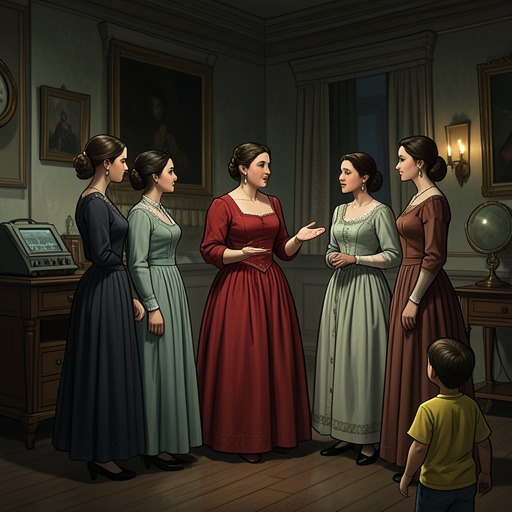
The Secret Society of Motherhood
Are We Having Fun YetThe Secret Society of Motherhood is Kay Willis’s defining metaphor for the gap between public advice about parenting and the private reality of living it. Motherhood resembles a secret society because initiation comes through experience rather than preparation: parents discover the difficult truths only after entering the role, while the most consequential knowledge remains concealed by shame, exhaustion, and the fear of appearing inadequate. Kay’s response is not another system of perfect instructions but a culture of disclosure in which parents exchange secrets, recognize one another’s struggles, and recover confidence and enjoyment.
Definition and Origins
Kay Willis often describes motherhood as a secret society whose members do not learn everything about it until after they have been initiated. Twenty years before the book’s account, the mother of ten from Rutherford, New Jersey, founded Mothers Matter on a remarkably simple premise: mothers should share their secrets in order to increase their skills, confidence, and enjoyment as parents. The educational and support program eventually helped thousands of mothers in hundreds of communities, turning private experience into a collective resource.
The metaphor has a darker companion in what Kay calls a “conspiracy of silence.” Parenting advice may fill pages, yet it does not necessarily prepare new parents for the recurring realities of exhaustion, tears, inadequacy, resentment, isolation, and guilt. The silence persists because parents may fear that admitting misery will make them seem unloving or incapable. The secret society therefore has two opposing meanings: it describes the unspoken knowledge that leaves parents feeling alone, and it suggests the fellowship that becomes possible once those experiences are spoken aloud.
The Hidden Experience of Parenting
The book places the secret society inside ordinary domestic strain rather than extraordinary crisis. New mothers may need rest, confidence, self-esteem, and adult conversation, but their days can instead be filled with fatigue and self-reproach. Kay’s own experience supports the argument. She remembers being exhausted and tearful with her first baby, feeling inadequate and guilty because nobody had told her what parenting would really be like. The point is not that every mother suffers identically, but that repeated emotional patterns are common enough to require recognition rather than private moral judgment.
The same logic appears in the account of pregnancy and large-family life. Kay enjoyed being the mother of ten children, but that enjoyment did not arise from unusual parental giftedness or ignorance of difficulty. It depended on support from her mother and husband, who repeatedly insisted that she mattered and that no one else could do what she was doing. Her mother made every Thursday afternoon a protected period away from the children so Kay could walk away, refuel, and return restored. Before the birth of the sixth child, she also arranged for a babysitter to arrive daily at five o’clock, explicitly so Kay could do nothing except rest, freshen up, and pull herself together. These practices expose a secret that isolated parents may miss: care for the caregiver is not an indulgence added after parenting is complete; it is part of making sustained parenting possible.
The account of a working mother who repeatedly insisted that she could cope gives the metaphor a further social dimension. Pregnancy, a transfer to a new job, a housekeeper’s departure, a threatened miscarriage, and a bus-line strike accumulated until she finally admitted that she could not cope. That admission released assistance from her mother and friends, who had been ready to help but had been held back by her insistence on managing alone. The story shows how silence can block not only sympathy but practical support, while an honest declaration of need can activate a network that was already present.
Initiation Through Shared Stories
Mothers Matter seminars dramatize initiation as a group process. In one northern New Jersey session, a grammar school principal with a six-week-old son confessed that she had joined mainly to find someone competent to care for the baby. She did not consider herself the mother type, disliked the new-baby stage, and wanted to return to work before using all her maternity leave. She also believed that her difficult pregnancy and refusal to hold her exhausted newborn in the hospital proved that she had failed to bond with him.
Her confession initially met silence, but another mother challenged the assumption behind it. Speaking with unexpected authority, the younger woman argued that first-time mothers may be too exhausted to understand or feel bonding immediately. Other mothers joined in, rejecting the idea that expert theory automatically described every family’s emotional reality. Their response relieved the principal’s guilt: the burden she had carried as evidence of personal inadequacy was reframed as a common experience that did not determine her capacity to love her child.
The initiation continued across later sessions rather than ending with one reassuring exchange. At the second meeting, the principal reported that her seven-week-old baby had smiled at her, and the other mothers recognized the joy because they had experienced the emotional force of a first smile themselves. By the final session, she announced that she would take her full maternity leave, perhaps longer, so she could remain with the child who had become her joy. The group’s applause marked a change in both feeling and decision: shared testimony had replaced guilt with permission to inhabit motherhood at her own pace.
From Private Circle to Public Authority
The secret society is not confined to face-to-face confession. Kay’s experience moves between seminars, book pages, television, magazines, newspapers, and commercial encounters, showing how local knowledge can become public parenting authority. At the first event where the narrator saw Kay in action, she was addressing more than one hundred people in a hotel ballroom. News headlines had called her a “professor of motherhood,” “every mother’s mother,” and a “human development pro,” while the audience responded not only to her words but to her attitude toward being a mother.
Kay’s public reach included Oprah, Good Morning America, The Today Show, The CBS Morning Show, The Home Show, CNN, and The Joan Rivers Show, as well as coverage in major newspapers and consumer magazines. The breadth of those appearances gave visibility to a form of expertise grounded in lived parenting rather than solely in institutional credentials. Mothers Matter also extended beyond mothers: one seminar session was devoted entirely to fathers, and Kay offered programs for new mothers, single parents, full-time earning-money mothers, parents of adolescents, and grandparents. The society’s membership could therefore expand across family roles and stages, even though its central language arose from mothers’ experiences.
Her Fisher-Price preschool toy camera campaign illustrates both the reach and the complication of that public authority. When a representative proposed a ten-city Christmas-season tour, the narrator initially refused because of demanding work and young children. She nevertheless insisted that Fisher-Price speak with Kay, who had founded Mothers Matter. During a phone interview, Kay learned that the company wanted a camera expert to travel across the United States for television and radio interviews. She sent the interviewer a dollar and a note betting that she could sell more toy cameras than the expert unless that expert was also a mother. At her meeting with the company president in upstate New York, she joked that she spent so much on toys that she had been putting Fisher-Price on her tax return for years; her humor won him over, and she got the job.
Kay became one of Fisher-Price’s most successful spokespersons, using the tour to discuss toys while carrying her broader message to parents in twenty-two cities. The limousine that replaced her usual station wagon became a playful emblem of the distance traveled from local motherhood to national visibility. Yet the commercial platform did not erase the concept’s origin. Her authority remained persuasive because the product promotion was joined to the recognizable experience of a mother speaking from within the world she described.
Meaning and Consequences
The Secret Society of Motherhood ultimately proposes that parenting knowledge should circulate horizontally as well as vertically. Experts and media can offer information, but parents also need other parents’ feelings, ideas, successes, failures, and practical examples. The book’s final discussion argues that the conspiracy of silence surrounding labor has been largely reduced by sex education and natural-childbirth classes, while the difficult reality of parenting remains much less openly discussed. The decisive preparation is therefore relational: parents become better equipped when they can name hardship without treating it as proof of deficient love.
This ethic also changes the meaning of competence. Kay tells mothers that they are the real professionals in parenting, and her confidence encourages them to believe both her and themselves. The claim does not celebrate solitary self-sufficiency. The stories repeatedly show competence emerging through a mother’s support, a husband’s partnership, a babysitter’s scheduled relief, a friend’s intervention, or a group’s collective recognition. A parent who admits exhaustion can receive help before fatigue impairs judgment; a parent who shares guilt can discover that a supposedly private failure is a common transition.
The concept’s deepest consequence is a revaluation of pleasure. Parenting is not presented as effortless, and the book does not deny resentment, nausea, fatigue, or isolation. Instead, it argues that enjoyment becomes more available when parents stop concealing the conditions that make enjoyment possible. The secret society begins as a structure of withheld knowledge, but through Mothers Matter and the narratives gathered around it, secrecy becomes shared understanding. What was once a lonely initiation becomes an ongoing practice of mutual recognition, support, and renewed participation in family life.